

International women's day 2026
International Women’s Day 2026 puts the global theme “Give To Gain” in the spotlight.
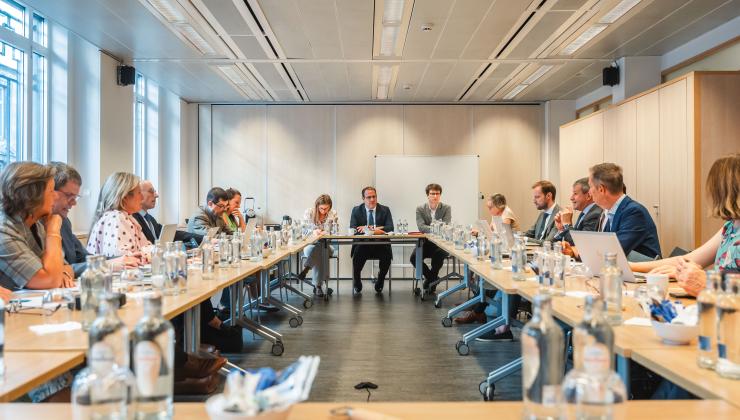
It is a reminder that sharing knowledge, offering support, and opening doors for others can drive real progress in workplace equality and collaboration. Inspired by this theme, pharma.be brought together its “Ladies of the Board” for a conversation on how this principle reflects in their day‑to‑day leadership.
Representing five major biopharmaceutical companies, Angela Thompson (AstraZeneca), Katrien De Vos (MSD), Marie‑José Borst (Roche), Roxana Botea (Johnson & Johnson) and Sara Schaufelberger (Amgen) joined Caroline Ven (pharma.be) to discuss how sharing expertise, creating opportunities, and supporting emerging talent can strengthen teams and improve outcomes across the industry.
Do significant barriers to gender equality remain?
This straightforward question marks the opener of the discussion.
Marie-José Borst emphasises that while she has not personally experienced gender related obstacles, the data however tell a different story. “About 70% of our sector’s workforce is women, but only 25% occupy senior leadership roles,” She also highlighted persistent gaps in medical research: "women are more frequently misdiagnosed in areas such as heart failure, face higher mortality from secondary diseases, and often wait years for diagnoses of conditions like endometriosis. Historically, clinical trials were designed by default for men,” she adds, underscoring the need for more inclusive research approaches. “There is still much work to do, scientifically and structurally.”
Katrien De Vos says; “While bias training and increased female representation have improved the landscape over the past decade, the remaining barriers are more subtle, and therefore harder to address. Career progression often peaks between ages 30 and 40, coinciding with “family prime time,” which can disproportionately affect women’s advancement. Mobility expectations, such as relocating for international roles, also remain harder for women to navigate."
Angela Thompson agrees: “there is unconscious bias that can manifest itself in various ways. Driven female leaders can be perceived as too assertive, not collaborative, or difficult to work with. I rarely hear the same feedback about driven male leaders. Why is that? Is it because, unconsciously, we continue to expect females to act in a nurturing fashion? When I hear comments about a female leader being too assertive, my response is always: “would you say the same thing if this colleague was male?"
Roxana Botea says progress is real, but bias hasn’t completely disappeared. “A female colleague recently asked me: ‘How do you take your space without being seen as too pushy?’ I couldn’t help thinking this is a question a man would probably never ask. There are also clear differences between countries. Before this role, I was the first woman ever appointed Country Manager in Romania for J&J. People were proud, they talked about it a lot, and many congratulated me. At some point, I told them: you know, I also do some other things besides being a woman.” (Laughter).
Sara Schaufelberger adds “Belgium is doing quit well in several regards” but she also pleads for acting on a broader truth. “Structural changes towards the treatment of women, for example regarding bias and even violence towards caregivers or first-time talents, are super important. We need to support that.”
Caroline Ven agrees by saying that “one size fits all” does not work. “We need to focus on specific needs. This goes for several groups, not only for women. I am shocked when reading in the media, that the announcement of departure of a large company’s CEO, is followed by the question Who will be the next top-man? A neutral wording, or mention of the next top-woman, never appears!”
Marie-José Borst concludes “We have evolved a lot. But we need more encouragement... just go for it! We will never improve innovation, deliver better business outcomes, if we do not have female voices at the table and reach real equity."

Ultimately the goal is to have diversity of thought around the table.

Gender equality is only the starting point.
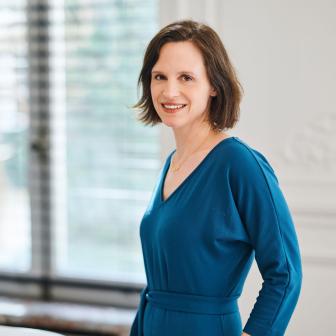
Today’s barriers to women’s advancement are no longer loud, but subtle and therefore harder to break.
Networking, Inclusion and the Real Work Behind Equality
During the discussion, the importance of networking and inclusion came up. Two elements the participants see as essential to advancing equality in the sector.
Caroline Ven highlighted the importance of being present in the right rooms. “Networking is a crucial part of career development. In my role, it is essentially the core of what I do,” she said. “Time is limited, so I make deliberate choices. I avoid attending women-only networking events. It is important to be present where the decisions are made, and in many cases, that still means being one of the few women in a room full of men. So that is where I want- and need to be.”
Katrien De Vos adds a personal experience: “Sometimes the difference in treatment of women is subtle and surprising. When I introduce myself at a networking event as the Managing Director of MSD, I am still asked how many people report to me or which degree I have. I often wonder whether a man would get those questions.”
Sara Schaufelberger agreed that while networks matter, they should not come at the expense of inclusion. “What is important in all these networks and initiatives is that they do not exclude others. At my company, we have global programmes to ensure minority groups are included. Every individual is treated equally, and gender equality is only the starting point. Both perspectives underline a shared message: meaningful progress depends not only on creating supportive spaces for women, but also on building environments where everyone, regardless of gender or background, can participate on equal terms.”
How did you try to make a difference?
Angela Thompson: “IThrough my mentorship, and more importantly, sponsorship, of early career professionals I will challenge them to be confident and to not feel pressured to look or act in a certain way in order to succeed. Ultimately the goal is to have diversity of thought around the table and we can’t achieve that if everyone around the table is thinking and acting the same. ”
Roxana Botea confirms: “In my career, mentorship has been highly important. It is all about encouragement to dare and dream bigger, take risks, and step forward. That is also my way of giving back to other women. Reshma Saujani, founder of Girls Who Code, said it starts from our childhood: boys are raised to be brave, while girls are raised to be perfect. This empowers boys to ask for more. If we would encourage girls to be braver, we could push some of these biases aside.”
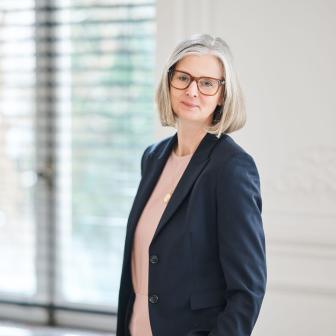
Sometimes you just need a mirror to show you to go for it!

If we would encourage girls to be braver, we could push some of these biases aside.

For more diversity, an inclusive approach is needed, not a “one-size-fits-all.
All Ladies of the Board agree: Sometimes we need to provide a mirror to show girls and women to go for it!
Did you know?
47% of all people working in Belgium's innovative biopharmaceutical sector are female employees.
47% of the management team or leadership team in Belgium's innovative biopharmaceutical sector is female.
In Belgium, 67% of the research team and 39% of the production team in the sector are women.
Source: pharma.be member survey 2026, among 46 participating companies
Également intéressant


Intéressé(e) à recevoir les nouvelles de pharma.be
Etre au courant de ce qui vit au sein de l'industrie pharmaceutique ? Inscrivez-vous à notre lettre d'information.