
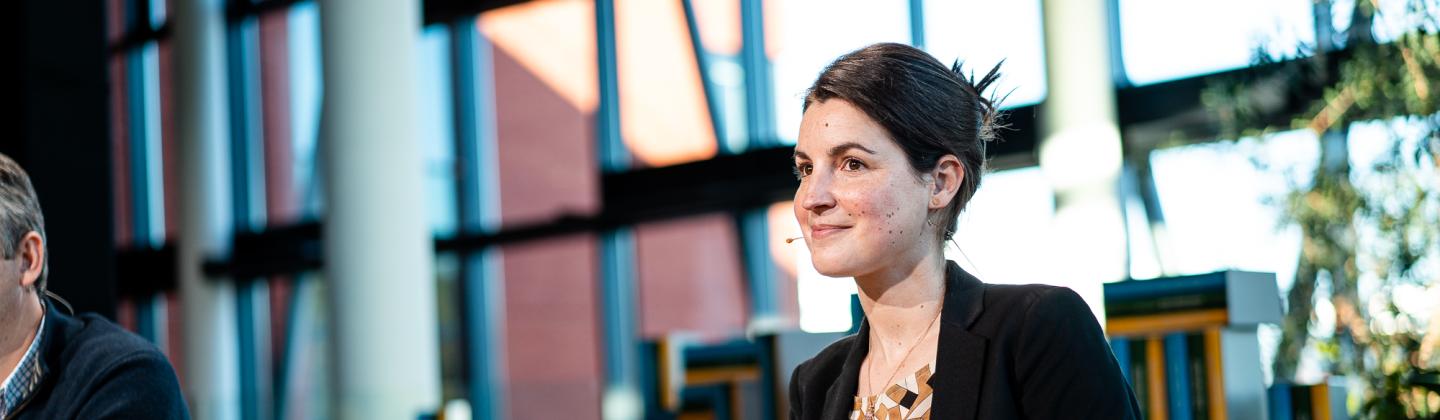
A conversation with Valérie Storms - “Clinical research saved my life”
Valérie Storms was born with cystic fibrosis and was also diagnosed with type 1 diabetes as a young adult. Drawing on her own experience, she has been campaigning for years to give patients a stronger voice in research, care and innovation. She is a board member of the European cystic fibrosis patient organisation (CF Europe), co-founder of the Patient Embassy at Hasselt University and a much sought-after keynote speaker . She is currently Head of Digital Health Innovation at Daiichi Sankyo Europe. She also holds a PhD in Bioinformatics from KU Leuven.
Her message powerfully emphasises the importance of clinical research: “Clinical research saved my life”. Her story illustrates how collaboration with patients not only leads to better insights, but ultimately also contributes to better care and new treatment options for future generations.
As a patient, have you taken part in a clinical trial? What did that opportunity actually mean to you at the time?
“When I was born 43 years ago with cystic fibrosis, there was actually no treatment available in Belgium yet. My parents were told that there was little chance I would live past the age of ten. My life has therefore been closely linked to medical innovation. First came treatments that alleviated the symptoms, such as mucolytics, digestive enzymes and antibiotics. Thanks to those treatments, daily physiotherapy and very diligent monitoring, I was able to reach the age of thirty, but by that time my health had deteriorated significantly and the pathogenic bacterium colonising my lungs had become resistant to almost all available antibiotics.
In 2013, I was given the opportunity to take part in a clinical trial involving a treatment that, for the first time, tackled not only the symptoms but also the underlying cause of cystic fibrosis. At that point, I had few other options left. Yet I didn’t say yes straight away. The trial protocol was particularly demanding, involving visits lasting more than nine hours and, at times, blood samples taken every hour. For someone who is already very ill and tired, this can represent a significant additional burden.
In the end, I decided to take part because I felt I had nothing to lose and because I knew that clinical trials are highly regulated and place great emphasis on patient safety. At the time, no one could predict just how significant the effect would be. Today, I’m still taking part in follow-up trials in which the treatment is being further improved.
For me, clinical research literally meant “timely” access to life-saving medicines. I am convinced that without that trial, I would no longer be here today. At the same time, it took another six to seven years before the treatment was reimbursed in Belgium. Not all the fellow patients I knew were able to survive that period. That is why I think it is so important that innovative treatments and clinical trials remain available in Belgium and Europe.”
Clinical trials are often associated with science, strict protocols and a data-driven approach. What about the human aspect of such a trial?
“A clinical trial demands a lot from patients who are often already unwell and tired. At the same time, there’s that very human sense of hope. You’re usually in a difficult situation and hope that the trial can offer a way out. But you don’t know whether the treatment will work, and in a blinded trial, you don’t know whether you’re receiving the treatment or a placebo either.
In my trial, it became clear quite quickly that the group receiving the treatment showed significant improvement. As a result, the placebo period was shortened so that the other participants could also gain access to the treatment sooner. I saw that as an example of care for the patient’s wellbeing.
Nevertheless, the original study focused primarily on the effect on lung function. As a patient, I noticed that the treatment had a much broader impact. My diabetes improved, I needed less insulin, my digestion improved and I was able to return to work. The impact on mental health was also significant. Such factors were not initially included as outcomes, even though they can be at least as relevant to patients.
A treatment does not affect a single isolated organ, but a person and their entire life. By involving patients, studies can better highlight this broader, more holistic impact – including towards the regulatory bodies and insurers .”
Was there a moment, or were there moments during your participation in the study when you felt like a genuine partner in the research, or was there still work to be done in that regard?
“To be honest, I didn’t really feel like a partner. The study was not only blinded in terms of the treatment, but also with regard to my own data. Before the study, I monitored my lung function very closely. That was my guide to understanding how my health was progressing. During the study, I suddenly lost access to those results.
Even after the study ended, participating patients received little or no information about the overall study results. We underwent a great many tests and made a significant contribution but were rarely told what our participation had actually achieved. Doctors and researchers do receive further information through conferences and scientific updates. For patients, that feedback is often lacking.
Practical support could also be improved. Follow-up is still largely paper-based, and patients are, for example, asked every three months what symptoms they have experienced. Digital technology could help to monitor symptoms more frequently, answer questions more quickly and provide better support to patients at home.
During the COVID-19 pandemic, certain tests, such as lung function tests, could be carried out at home. Afterwards, we had to return to hospital for every test. That’s a shame. More hybrid studies, in which patients can monitor certain aspects at home, could significantly reduce the burden.”
In your view, what do researchers, doctors and companies stand to gain by involving patients earlier and more actively in the development of new treatments?
“Patients view a treatment differently from researchers or doctors. They experience not only the clinical effect, but also what a treatment means for their daily lives, their mental health, their work and their independence.
By involving patients right from the development of the study protocol, researchers can determine which outcomes are truly relevant to them. They can also assess whether the demands of the protocol are manageable for someone who is already unwell and fatigued. This can lead to studies that are more patient-friendly, more inclusive and, at the same time, gather evidence that relevant provides a more complete picture of a treatment’s value.
This broader perspective can also be relevant when assessing and reimbursing medicines. When you can demonstrate not only that a treatment improves a specific medical indicator, but also that people are able to return to work, end up in hospital or at the physiotherapist less often, or function better, you gain a more complete picture of the societal impact.”
If you could convey one message to policymakers about access to clinical trials and health innovation, what would it be?
“Policy can really make a difference. The European regulations on orphan drugs, which encouraged companies to conduct research into rare conditions, have shown that the right political incentives can lead to more research and new treatments.
We must therefore continue to invest in an environment that attracts and accelerates health innovation. In my case, it took six to seven years before a treatment with very strong results was reimbursed in Belgium. For seriously ill patients, that is an exceptionally long time. There is also a risk that companies will launch fewer trials in Belgium or Europe if innovation finds it harder to reach patients here.
We must avoid that. Patients should not have to travel to the United States to gain access to innovative treatments that are not available here. Healthcare must remain a priority, with smart incentives, an attractive environment for clinical research and faster access to proven innovation.
Medicines are not just an abstract cost item in this context. Before my treatment, I was frequently admitted to hospital and required intensive care. Thanks to innovative medication, I now lead a full life, I am able to work and can once again contribute to society.”
What has been your experience of collaborating with the sector on the development of clinical trials, for example regarding the protocol, patient information and outcomes?
“There are some good initiatives, but there is still room for improvement. Patients need to be involved at an earlier stage in drawing up protocols, determining relevant outcomes and developing patient information that is easy to understand. This way, trials can better reflect their everyday reality.
I have also contributed to a Belgian information platform on clinical trials. Its aim is to make trials taking place in Belgian hospitals accessible to patients in clear and understandable language. This is important, because access to clinical research should not depend solely on the doctor with whom someone happens to be receiving treatment.
A patient must be able to find out for themselves which trials are underway and discuss them with a doctor. A trial at another hospital can sometimes offer a significant opportunity. Providing information directly to patients strengthens their position and gives them greater control over their own care journey.
Collaboration between the sector and patient organisations on such initiatives is valuable. But genuine collaboration also means that patients are not merely participants. They must be able to help shape the direction of the trial, receive better support throughout the process, and find out afterwards what their contribution has achieved.”
Également intéressant


Intéressé(e) à recevoir les nouvelles de pharma.be
Etre au courant de ce qui vit au sein de l'industrie pharmaceutique ? Inscrivez-vous à notre lettre d'information.